
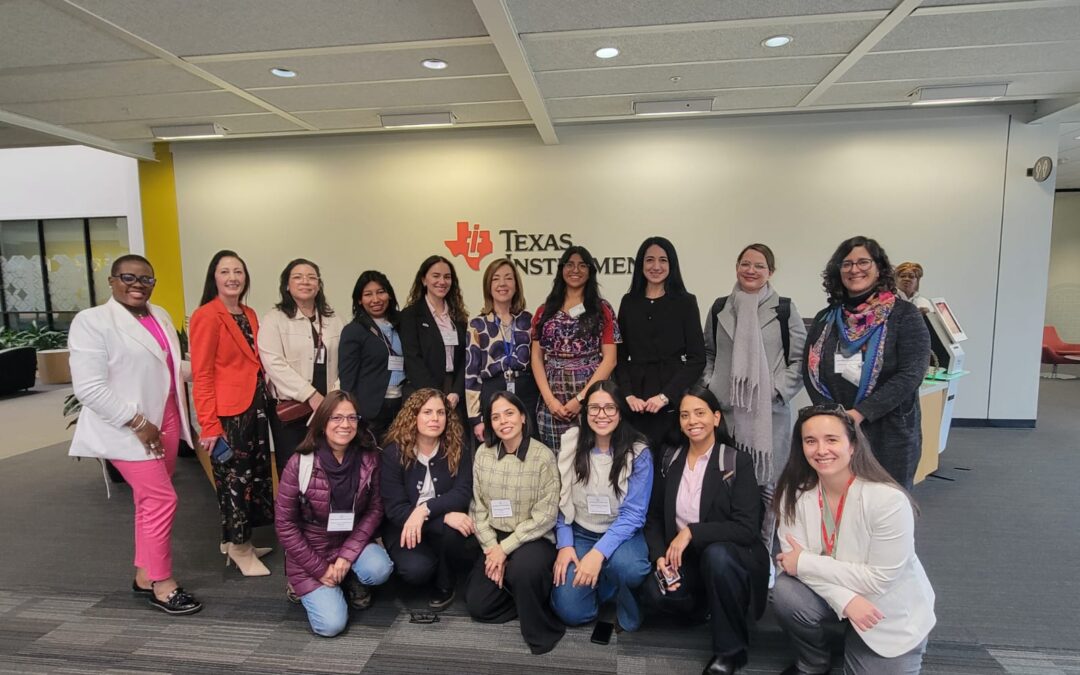
Twelve countries. Thirteen women. One room on the Texas Instruments campus in Dallas.
They came from Argentina, Chile, Colombia, Costa Rica, the Dominican Republic, Guatemala, Honduras, Mexico, Nicaragua, Paraguay, Peru, and Uruguay — professors, researchers, nonprofit founders, policy leaders, and board members, each working in her own context to strengthen STEM pathways.
Sponsored by the U.S. Department of State’s International Visitor Leadership Program (IVLP) and coordinated locally by the World Affairs Council of Dallas/Fort Worth, the delegation gathered to wrestle with a universal question: how do we make sure girls don’t lose interest in STEM before they ever really find it?
High-Tech High Heels had the privilege of hosting that conversation.
The Problem Looks the Same Everywhere
There’s a pattern. Across every country in that room, interest in STEM starts broad and narrows around middle school as exposure gaps widen, encouragement becomes uneven, and confidence erodes. By the time students choose their paths, many have already been steered away from technical fields — or were simply never invited in.
Policy environments and resources differ, and in some regions the barriers are sharper. But the shape of the challenge is nearly identical. That’s both sobering and clarifying. No country has solved this problem on its own, which makes shared learning not just helpful, but necessary.
More Than Curriculum
Expanding STEM participation isn’t simply a matter of improving curriculum or coursework. Curriculum matters, but it doesn’t stand alone. Without family engagement and sustained partnerships, even well-designed programs lose momentum and talent goes undeveloped.
The leaders in that room weren’t interested in theory; they wanted to understand how initiatives actually operate — how partnerships are structured, how outcomes are measured, and how momentum is maintained. The focus was on what makes the work durable.
What Stood Out
The commitment to strengthening STEM pathways is truly borderless. While policy environments differ, the core challenge is shared, as is the determination to address it.
We spoke candidly about corporate engagement and the role companies play in advancing this work. The strongest partnerships create value for both the community and the company. When organizations invest in expanding access to STEM, they are helping students explore new possibilities while also strengthening the future workforce. Recognizing that alignment makes partnerships more durable and effective.
Leaders across the region are navigating evolving public conversations about education and workforce development. The discussion wasn’t ideological or abstract. It stayed practical and focused on outcomes: expanding access to opportunity and ensuring talent is identified and developed wherever it exists. When women are underrepresented in technical fields, the implications are economic, not symbolic.
The Value of Exchange
Programs like the IVLP create space for direct exchange. Sitting in the same room and comparing what’s working — and what’s not — builds understanding that reports and conference panels rarely achieve. A model piloted in Montevideo may inform something in Dallas, and vice versa.
Hosting this delegation was a reminder that the work happening in our local communities is connected to a bigger mandate. Talent is universal, even when opportunity is not. Strengthening the systems that narrow that gap requires sustained collaboration.
We’re grateful to the World Affairs Council of Dallas/Fort Worth for coordinating the visit and to Texas Instruments for hosting. If you’re working on expanding STEM pathways or building partnerships that last, we’d love to connect.